

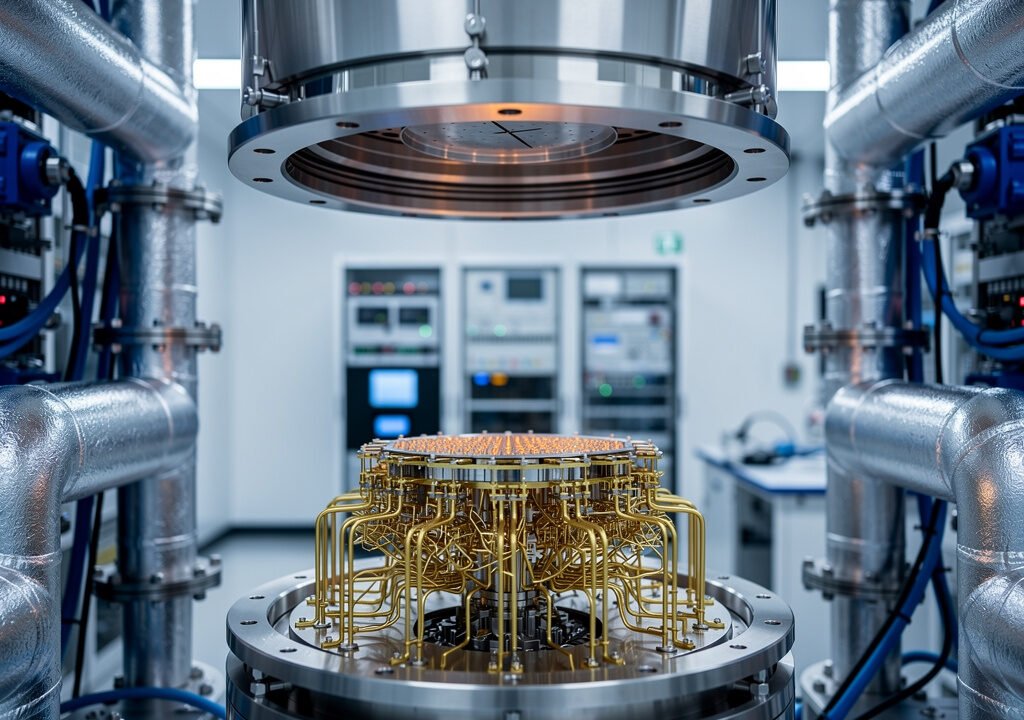
Quantum computing and artificial intelligence are converging to create the next technological revolution. As we approach 2025, this powerful combination promises to solve complex problems that traditional computers and AI systems cannot tackle alone. According to Google’s AI Research team, quantum computing could exponentially accelerate AI model training and inference.
How Quantum Computing Enhances AI Systems
The integration of quantum computing with artificial intelligence represents a paradigm shift in computational capabilities. These advanced systems can process vast amounts of data simultaneously through quantum superposition and entanglement, enabling more sophisticated AI algorithms.
Quantum Computing Applications in Modern AI
- Machine Learning Acceleration: Quantum algorithms can optimize neural network training
- Complex Problem Solving: Quantum AI tackles optimization challenges exponentially faster
- Drug Discovery: Combined systems analyze molecular interactions more efficiently
- Financial Modeling: Enhanced risk assessment and market prediction capabilities
Furthermore, recent research in Nature Machine Intelligence demonstrates quantum computing’s potential to revolutionize deep learning architectures. Explore quantum algorithms in detail.
The Future of Quantum AI Development
As quantum computers become more powerful, their impact on AI systems grows exponentially. Industry experts predict significant breakthroughs in:
Quantum Computing Milestones for AI
- Quantum Neural Networks: Next-generation AI architectures
- Error Correction: More stable quantum computations
- Hybrid Systems: Classical-quantum computing integration
Moreover, quantum machine learning advances continue to push boundaries in computational capabilities.
Practical Applications and Industry Impact
The convergence of quantum computing and AI is transforming multiple sectors:
- Healthcare: Accelerated drug development and personalized medicine
- Cybersecurity: Enhanced encryption and threat detection
- Climate Modeling: More accurate environmental predictions
- Financial Services: Complex risk analysis and trading strategies
These applications demonstrate the practical benefits of combining quantum computing with AI technologies.
Challenges and Opportunities
While quantum computing shows immense promise for AI advancement, several challenges remain:
- Hardware Limitations: Maintaining quantum coherence
- Cost Considerations: Infrastructure investment requirements
- Talent Gap: Need for specialized expertise
- Implementation Complexity: Integration with existing systems
Despite these challenges, organizations continue investing in quantum AI development, recognizing its transformative potential.
In conclusion, quantum computing represents the next frontier in AI advancement. As hardware capabilities improve and algorithms become more sophisticated, we can expect breakthrough applications across industries. The future of computing lies in this powerful convergence of quantum systems and artificial intelligence.











No Comments